Back to Mission Systems

Pilot Offer

PASSIVE-SHIELD C-UAS sensing and fusion pilot.

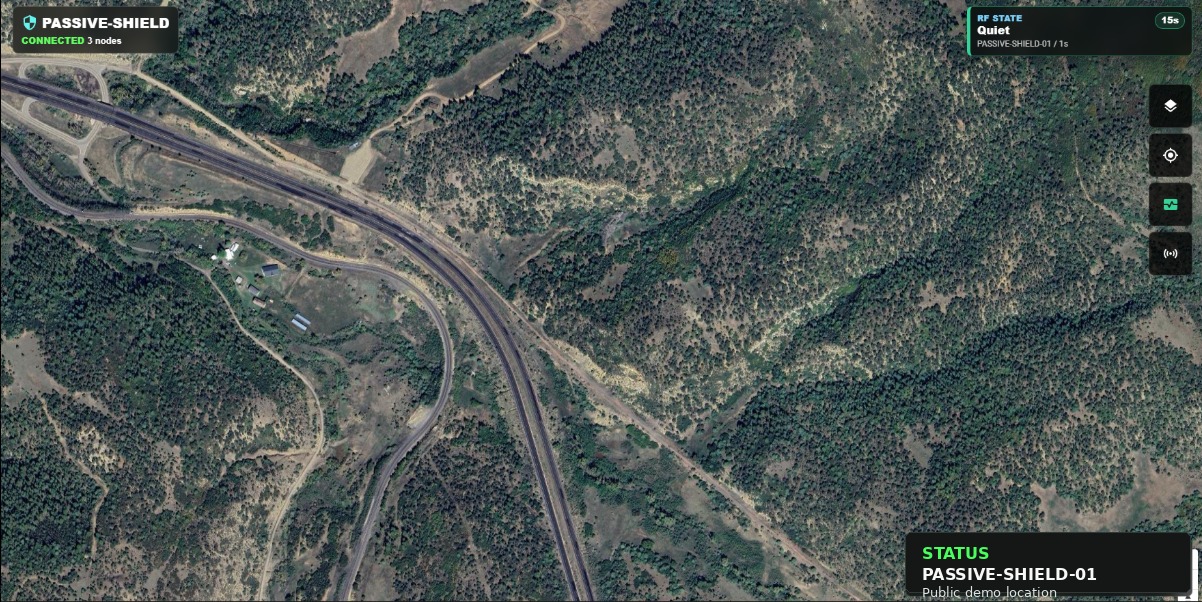
A bounded engineering pilot for passive RF evidence, acoustic corroboration, sensor-placement review, deterministic swarm replay, GeoFusion analysis, and C2-ready operator cues.

Pilot Focus

Turn prototype evidence into a controlled evaluation package.

The pilot is designed for teams that need to evaluate passive-first C-UAS sensing, sensor fusion, and operator workflows before making deployment claims. RTG uses PASSIVE-SHIELD and the broader RTG Spectrum event model to connect observations, preserve source context, analyze uncertainty, and produce reviewable evidence.

The result is not a generic demo. It is a scoped technical package: assumptions, configuration, replay scenarios, event schemas, operator views, measured limitations, and an acceptance-style report.

Who This Fits

  • Defense and public-safety teams evaluating detection-focused sensing workflows
  • Sensor vendors that need normalized events, fusion, dashboards, or C2 output
  • Primes or integrators looking for passive RF, GeoFusion, replay, and operator software support
  • Engineering teams preparing for controlled tests, pilots, or partner demonstrations

Pilot Deliverables

A practical package for controlled C-UAS sensing review.

Site Assumptions

Mission context, coverage assumptions, operating boundaries, expected clutter, communications constraints, and legal/customer authority notes.

Sensor Placement Model

Recommended node geometry, likely blind spots, station-health requirements, timing assumptions, and follow-on collection routes.

Replay Scenarios

Versioned single-drone, staged-activation, mass-arrival, simultaneous, mixed, and negative-control replay cases with ground truth kept separate.

Event Schemas

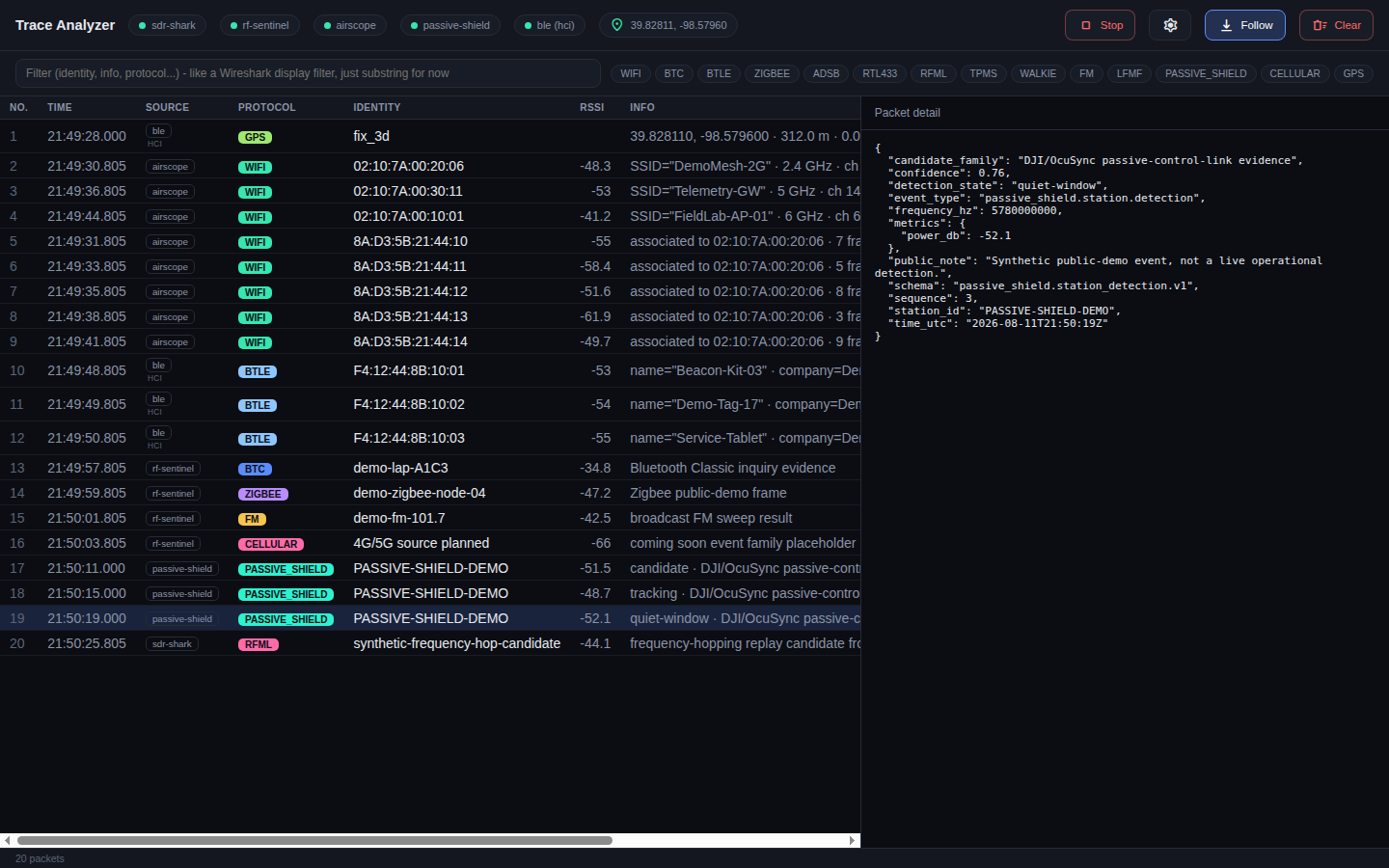
Detection, station, track, group, GeoFusion, hypothesis, health, and C2-output fields documented for repeatable review.

Dashboard and C2 Output

Operator review surfaces, source-aware timelines, map cues, CoT/WebTAK-ready output paths, and customer-specific interface planning.

Acceptance Report

Measured results, known misses, false positives, confidence boundaries, data-quality notes, and recommended next engineering steps.
Capability Summary

A procurement-style data sheet in page form.

This page is intentionally structured like a lightweight data sheet: what the pilot includes, what evidence exists now, what outputs are produced, and what claims remain out of scope until validated in a controlled customer environment.

Category Pilot Scope Representative Output
Collection Passive RF, acoustic, station health, customer sensor inputs, and adapter-ready external observations Source-aware detection and health events
Fusion Duplicate suppression, track lifecycle, staged activation, spatial residuals, and conservative hypothesis generation Track, group, GeoFusion, and hypothesis records
Operator Output Map cues, event timeline, confidence notes, C2-ready outputs, and reviewable evidence Dashboard views, CoT/WebTAK-ready cues, and report figures
Acceptance Evidence Replay validation, measured misses, known limits, configuration notes, and recommended follow-on tests Acceptance-style result report

Public-safe result card

Swarm replay and GeoFusion evidence are already producing measured limits.

Current PASSIVE-SHIELD work combines staged-activation detection with multi-station GeoFusion residuals. The useful result is evidence discipline: sequential behavior can be named, spatial spread can be detected in simulation, and ambiguous cases stay ambiguous instead of being forced into unsupported coordination claims.

Current Evidence

  • Six deterministic multi-drone scenarios with ground truth
  • Level-shift validation matched staged joins in nine of twelve track-band series
  • GeoFusion residuals separated the single-drone baseline from spatially spread multi-source scenarios in simulation
  • Swarm hypotheses remain conservative when coordination cannot be supported
Evidence Area Current Result What It Supports Boundary
Staged activation 9/12 staged-source track-band joins matched in replay validation Sequential launch and source-join cues Not reliable aircraft count
GeoFusion residual Single-drone baseline separated from spatially spread scenarios in simulation Single-source vs. not-single-source evidence Not internal formation resolution
Hypothesis fusion Sequential wave named; ambiguous cases remain bounded Operator-facing evidence summaries No proof of coordination from RF evidence alone

What is not claimed

Bounded claims make the pilot more useful.

The pilot is structured to identify what the evidence supports, what remains ambiguous, and what would require additional authority, sensors, station geometry, calibration, or external validation.

Boundaries

  • No jamming, spoofing, kinetic defeat, or mitigation claim
  • No fielded operational C-UAS claim
  • No reliable physical aircraft count from a single combined RF signal
  • No proof of coordination from RF evidence alone
  • No universal drone-family detection, payload, pilot-location, or precision-geolocation claim

Partner with RTG

Built for evaluators, sensor vendors, and integrators.

RTG can help teams convert detections into normalized observations, persistent tracks, GeoFusion evidence, replay fixtures, dashboard views, C2-ready cues, and acceptance-style reports.

Partner Categories

  • Sensor vendors with RF, acoustic, radar, EO/IR, or Remote ID observations
  • Defense and public-safety evaluators planning controlled sensing pilots
  • Primes and system integrators that need edge software, event fusion, or C2 integration